
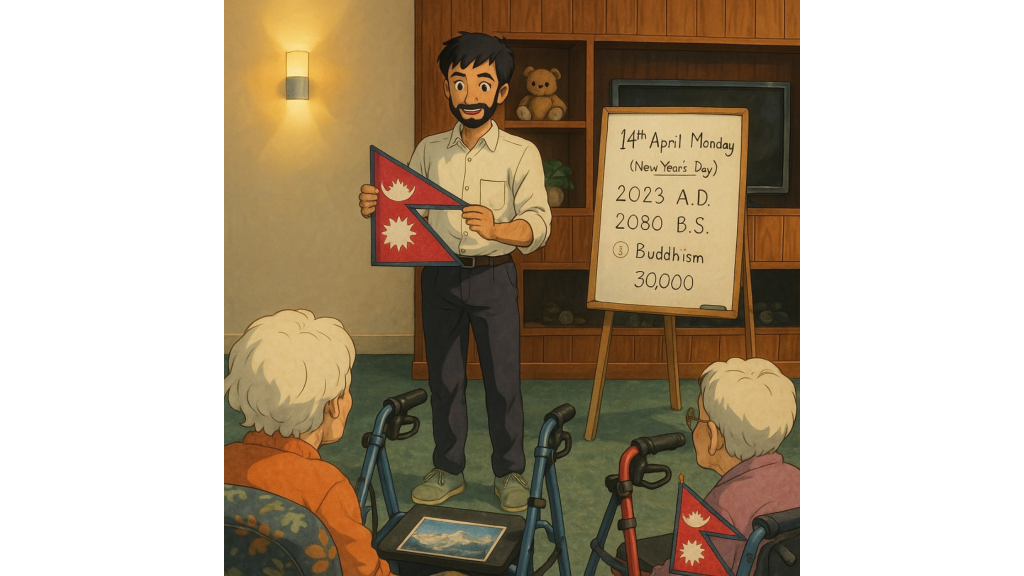
On April 14th, 2025, I celebrated my first Nepali New Year in Australia, and I did it entirely on a whim.
As I oversee the recreational and wellbeing department at my workplace in a multicultural residential community, I must keep my brain working to come up with exciting, engaging and fun methods and initiatives that not only enhance the wellbeing of the community but also incorporates cultural, spiritual, physical, and emotional dimensions of the community residents. With every Nepali festival approaching, I naturally find myself engaging in an extra layer of creative thinking. However, with recent experience of attempting to bring together my fellow Nepali colleagues to celebrate and exchange culture with Australians, the turnout was not very motivating. Which is probably the reason I couldn’t manage to think of anything for this New Year. By the morning of Nepali New Year Bikram Sambat 2082 itself, I still hadn’t planned a thing. Yet I knew, deep down, I wanted to introduce this joyful festival to the community.
I drove to my office, reaching my desk by half past eight as usual, turned on my computer and started typing ‘Nepal Information Book’ into Google, and printed out a few copies. Asked my staff to let everyone know that we’d be hosting a special ‘Morning Trivia & Learning session on Nepal’ that day. At 9, I grabbed a whiteboard, scribbled ‘Happy Nepali New Year 2082!’, and jumped onto the floor. Pulling my staff aside, I announced welcome to Morning Trivia & Learning session on Nepal! To my surprise and delight people began to gather around. I commenced the Trivia by introducing myself as someone from Nepal who recently moved to Australia. A few looked at me with surprise, others already knew but all greeted me with warm smiles. It felt like a beautiful start to what I didn’t realise would be a meaningful morning.
I swiftly erased the ‘2082’ from the board and turned it into a challenge. “Noticed what’s on the board?” I asked. “Today is Nepali New Year. What year are we entering today?’” Guesses flew in: “2025?” “2026?” I shook my head and the room fell silent. I could tell from their puzzled faces that this was going nowhere. I had to give a clue. “It’s way ahead of 2025… but not 2100 yet. Any guesses?” Murmurs, slurry, soft voices: “2040?”, “2050?”, … Still no answer. With another clue “Between 2080 to 2090”, I followed. Finally, one bold voice blurted out, “2082?”. “Correct!” I cheered it, and was met immediately by his stunned, even frustrated response, “How is that even possible?” Another silence followed, until someone posed a query “Do you have less than 12 months a year? Maybe that makes the year pass quicker?” Someone else chimed in “Is it something to do with the moon cycles? Does your calendar follow the moon or something?” That spark of curiosity lit up the room. I explained that Nepal follows the Bikram Sambat calendar, set way before the Gregorian. Faces relaxed; and soon, questions tumbled out.
I don’t very often get to see that inquisitiveness and attentiveness in our usual sessions which increased by four folds as my fellow staff members joined the intrigued expressions. We then dove in the flag fun. “The world’s only non‑rectangular national flag is of Nepal; now guess it’s shape” I began as I handed out to everyone printed copies of the flag. Yet again, confusion rippled through the group, probably the silent “WHY” question dancing in their brains; “Why was the flag so uniquely shaped!” One curious head goes, “Was it changed later to make it unique?” Before I could respond, one of my staff members couldn’t resist pulling out the phone from her pocket to Google and found out it wasn’t changed. They learnt of the twin triangular shaped flag and the sun and moon, symbolizing the eternal existence of Nepal; as long as there is the sun and the moon in the sky, Nepal shall endure. And when they happily held up the Nepali flag for a photo, smiling and engaged, it truly made my day.
Jumping into the geography and majestic mountains of Nepal, I said “While South Australia is about six times larger than Nepal in total area, Nepal’s population density far exceeds that of the entire Australian continent.” That contrast alone raised a few eyebrows. Every fact I shared about Nepal, each question I posed, each answer that followed, was met with genuine surprise, curiosity, and a few delighted gasps from the older Australians. I was absolutely loving the atmosphere, my mind ticking along, searching for the next intriguing detail to offer.
Then came the mountains, “What’s the highest peak of the world and where is it?” I asked. A proud grin accompanied the chorus: “Mount Everest and Nepal!” I followed up quickly: “And out of the world’s top ten highest peaks, how many do you think are in Nepal?” Silence. Some thoughtful murmurs. When I revealed the answer, “eight”, a fresh wave of astonishment swept through the room again.
I kept the energy going, encouraging them to guess Nepal’s national animal. I started with a clue: “It’s domestic.” The guesses came quickly, “Cat!” “Dog!” “Sheep!” “Pig!” The room buzzed with excitement. Then I added, “It’s farm friendly… but bigger than a pig.” That narrowed it down just enough. Someone called out “Cow,” and a visiting guest burst into laughter. That simple moment sparked a warm wave of connection, we all shared a light-hearted laugh, united in the joy of guessing games and cultural exchange.
I shared my journey to Upper Dolpo, one of the most remote regions of Nepal, following one of Asia’s most dangerous trekking routes, soaring above 5000 meters from sea level. It began with a road trip from the capital city, followed by a flight, then an exhausting 18-hour continuous trek. I spent a night under the open sky at around 4800 meters, without a sleeping bag, only wrapped in the chill of the mountains and the lurking fear of altitude sickness. The adventure continued with a full day of mountain biking across the Himalayas, then a day on horseback, one of those once-in-a-lifetime travel experiences I’ll always carry with me, especially now, living in Australia. Their attentiveness, quiet but genuine, passively encouraged me to share more of my stories. And just then, a new Nepali staff member passing by, seeing me holding the Nepali flag, couldn’t help herself and called out loudly, “Happy New Year!!”
Weather became another topic of discussion. I shared how, from the Terai plains to the hills and up to the Himalayan heights, a road trip in Nepal can feel like travelling through three worlds in a single day. Someone chimed in, “Is it like Melbourne, four seasons in one day?” Laughter rippled through the group. I wrapped up by touching on Nepal’s uncolonized history, the ancient Pashupatinath temple, and the birthplace of Buddha in Lumbini, each revelation met with gasps and a round of applause. I reminded them that Nepal is home to the world’s oldest language, religion, and system of medicine, truly a land of timeless wonders.
No one quite realized when the trivia session subtly turned into a travel experience exchange. Questions began pouring in from the other end, I was now the one answering their endless curiosity, even though I was meant to be moderating the trivia. What had started as a nerve-wracking gamble unfolded into a vibrant, impromptu social studies class, except my ‘students’ were seasoned travellers and staff from across the globe. Their curious faces, earnest questions, and the joy in their voices as they shouted out answers filled me with pride, energy, and a profound sense of connection.
That morning, I didn’t just celebrate the Nepali New Year, I brought a slice of my homeland into Australian hearts and lives. As I looked around, I realized it truly was the first day of the year. And in our culture, we believe that whatever we do on this day tends to echo through the entire year. If that’s true, then I hope this year will be full of stories, shared smiles, learning, and cultural connection. I can’t wait to create more moments like this for our community, all year long.
Jay Nepal! Happy New Year 2082 and beyond.