
It was the 8th of January a morning wrapped with clouds. I left home at exactly 10:30 AM, carrying more than just bags in my car. There was something quieter, heavier, a sense that I was driving into a new version of myself. I was heading to Naracoorte to begin my first ever job in Australia. Just five months into this new country, and I was already going 110 km/h down long stretches of unfamiliar highways.
Daws Road became South Road, which merged into Cross Road, and soon I was on the M1 the Southeastern Freeway and eventually the A1 and A8. I remember checking road signs like I was reading a new language yet somehow trusting my instinct. There were names that rolled off the tongue like a country song, Tailem Bend, Cooke Plains, Yumali, Kiki, Coonalpyn, Coombe, Keith. At Keith, I left the main highway and turned right. That’s when it really began to feel like I was entering a different space altogether. Willalooka, Padthaway, Keppoch until finally, Naracoorte.
The road to Naracoorte was long, but quietly beautiful. I drove my 2009 Ford Focus through sweeping landscapes that, until then, I had only seen in Western movies. Once I passed Monarto, the surroundings grew more rustic, evoking a strange, comforting familiarity like driving through the plains of Nepal’s Terai districts. It was just my imagination, perhaps, but in that moment, the unfamiliar felt oddly close.
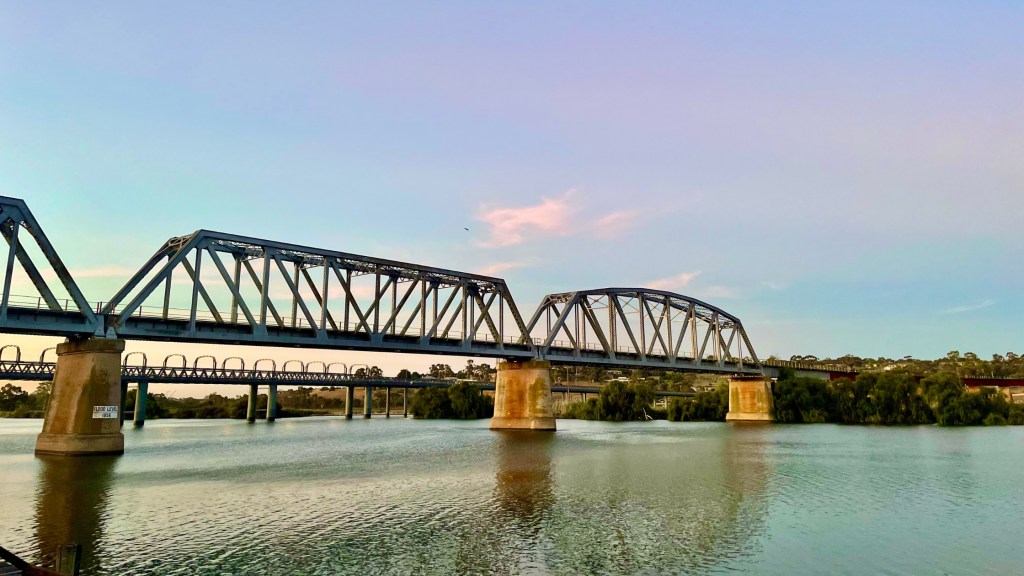
Then came the Swanport Bridge, stretching gracefully over the wide, slow-moving Murray River. I hadn’t expected a river crossing here, not like this. But there it was, unexpected and striking. This moment stayed with me. Later, I learned a bit about it, the Murray is Australia’s longest river, winding through three states and forming a lifeline for agriculture, ecology, and history. The Swanport Bridge itself is a critical piece of infrastructure, forming part of the Princes Highway that connects Adelaide to Melbourne. Completed in 1979, it replaced the old ferry service at Murray Bridge and became a vital crossing that reshaped road transport between South Australia and Victoria.
In a strange way, it reminded me of the Trishuli River back home, how it flows alongside the Prithvi Highway, connecting Kathmandu to the rest of the country. Or like the Narayani, running strong beside Muglin and Narayanghat, its presence always felt during those long bus rides. There too, rivers were more than just the water, they shaped the roads, the pace, and the stories of travel. Crossing the Murray felt like passing through a familiar chapter written in a foreign script. Different country, different story, but the same quiet power of a river carving its place into memory and land alike.
I saw vineyards and cattle farms; with animals I couldn’t even identify at first glance. There was a kind of rhythm in the road, keeping an eye on the speedometer, in the long overtakes past massive freight trucks, the shudder of my car as stones hit the windshield. And through it all, the CD player played my old Nepali and Hindi songs. Some of them made me smile. Others reminded me of where I came from. But mostly, they just kept me company.
As I drove deeper into the countryside, the FM signals grew weaker. Static took over. So, I switched to local radio, half listening to Aussie accents sharing community updates, event announcements, traffic news. It was comforting in a strange way, like being let in on someone else’s inside jokes.
Four hours later, I was standing at the entrance of Naracoorte Hospital. For a second, something about the building struck a nostalgic chord. I was reminded of my Baba’s workplace, the District Public Health Office in Arghakhanchi. I wasn’t sure exactly why. Perhaps it was the shared government structure, or the slightly aged but dignified layout, the calm, serious air of the place that quietly held people’s lives in its hands. Maybe I just missed him.
At the hospital reception, I introduced myself. They were already expecting me. There was something quietly affirming in that, to be expected. I was handed a key marked “Room 7.” That small moment unexpectedly brought a smile. Lucky number? I didn’t know. Maybe. But something about it felt just right.
I met my manager, the Nurse Unit Manager, the person I’d be reporting to. Her presence was grounded, calm, and warm in that typical Australian way. I was shown around the hospital corridors with quiet footsteps, nurse stations with the low murmur of diligence, staff rooms with the smell of coffee and sterilizer. As I walked behind her, waving at strangers who were about to become colleagues, I was silently registering everything; sights, sounds, routines, and trying to keep up with what it meant to be there.
That night, I entered Room 7 for the first time. It was nothing grand, just a single room with a large window, a bed, a fridge, a wardrobe, and a sink. But that night, it became everything. It was mine. No sharing, no hostel clamour, just me. The window looked out onto the garden, and from the very first night, I kept the curtain slightly open just enough to let in the green. The trees outside stood in quiet witness, as if they knew I’d need their calm. I remembered the noise of undergrad hostels, where I never cooked, never had much privacy. But this was a new chapter, and I had to cook for myself now or no one else was going to feed me.
The kitchen was shared, lined with paper notices and scribbled memos. “Clean up after use,” “No loud noises after 9 PM,” “Label your food.” These rules felt less like discipline and more like an introduction to the rhythm of this new space. I opened the fridge, unpacked some snacks, and told myself, you’ve made it this far. You’ll figure this out too.
It was the first night without my hooman being in over five months. The absence sat quietly beside me as I ate my first solo meal. I missed the warmth. But at the same time, I felt something unfamiliar, not loneliness, but a strange, quiet pride. I had driven myself here. I had accepted this job offer because I was chosen. I had knocked on a new door, in a new town, a new world, not out of desperation but readiness.
The next morning was my first official day. Signing confidentiality agreements, learning door codes, setting up my government email, each step felt more permanent, more real. My manager accompanied the Director to personally show me my office space, a large lifestyle office, surprisingly big, and entirely mine. Their humility, the sincerity in their welcome, it felt genuine. They weren’t just welcoming an employee. They were making space for a person. And that feeling lingered. It still does.
As I now sit back in Room 7, the same room I entered with a flutter in my chest, I can’t help but reflect. What gave me the courage to drive 338 kilometres into the unknown? What allowed me to walk into that hospital door with calm confidence? Perhaps it was the unspoken belief that I belonged there, that I had earned my way, and this was just the beginning.
Maybe it was the roads, the rivers, the radio static, and the quiet green outside the window that slowly stitched that belief into me. Whatever it was, I’m grateful for it. And I’m even more grateful I took it.